How to measure ’popular’ when there is no PSKReporter
The earlier amateur-band report could rank modes by spot counts, because FT8, RTTY and PSK31 stations report each other to public networks. Nothing like that exists for professional HF traffic. Military operators do not publish logs, much of the traffic is encrypted, and coast stations and aeronautical networks run under their own frequency allocations, well away from the amateur bands. “Popular” therefore has to be pieced together from four kinds of evidence:
- Aggregated reception data where it exists. Aviation’s HFDL is the one professional mode with a public, crowd-sourced picture. Hobbyist receivers running the open-source dumphfdl decoder feed Airframes and hfdl.observer, which show which ground stations and frequencies are active at any moment4.
- Regulatory carriage requirements. For ships, what is mandatory tells you what is on the air. HF DSC is watched by coast guards, while HF narrow-band direct printing (NBDP) was dropped from the GMDSS on 1 January 202489.
- Monitoring-community status flags. The Signal Identification Wiki (sigidwiki) marks each signal active, inactive or intermittent, and points to the Utility DXers Forum logs for month-by-month usage of modes such as STANAG 4285121.
- Vendor and standards documents. These say which waveforms are still “in use” and which are “rare”. RapidM’s waveform table is an example2.
The resulting ranking is qualitative and you should read it that way. None of the sources gives a share figure comparable to FT8’s share of amateur spots, and this report does not invent one.
The short list: what you will actually hear
If you tune 2–30 MHz with an SDR and a wire antenna, most of the non-amateur digital signals you meet will come from a fairly small group of modes. The tiers below are this desk’s judgement. They rest on how reliably each mode can be found, how many users carry it, and whether the sources describe it as current. They are not traffic measurements.
- HFDL (HF ACARS)16 ground stations
- STANAG 4285NATO broadcast/BRASS
- 2G ALEmost ALE in use
- HF DSCGMDSS distress
- Radiofax (HF-FAX)NOAA, DWD
- MIL-STD-188-110 / STANAG 4539serial tone + 5066
- Weather RTTYDWD 50 Bd
- CIS-12 / Russian modems
- OTH radar29B6 very active
- PACTOR (SailMail, Winlink)
- Link 11
- SITOR-B / HF NAVTEX
- DRM broadcasting
- HF trading links▲proprietary
- 4G ALE / wideband HFNew
- Link 22
- STANAG 4529’rare’ per RapidM
Desk judgement from sigidwiki active flags, RapidM ’in use/rare’ status, USCG and IMO carriage rules and HFDL aggregator data, as of November 2026.
Why the tiers fall this way
The S tier is made up of systems that run around the clock on published frequencies. Each HFDL ground station keeps several channels active at all times and moves them as propagation changes4. Ships’ HF DSC watch is mandatory, so coast stations transmit acknowledgements and test calls every day8. STANAG 4285 is the waveform behind NATO’s ship-shore broadcast systems, and RapidM’s table lists it as “in use” for “NATO BRASS Systems, B/Cast Systems”2. Broadcast transmitters often key up continuously, which is why 4285 is so easy to find. Sigidwiki says the “vast majority” of ALE systems in use are still second generation, and their short sounding bursts turn up across the HF spectrum15.
The A tier is scheduled or ubiquitous traffic. Radiofax and weather RTTY follow published timetables1011. The MIL-STD-188-110 serial tone is the default data modem under STANAG 50662. Russian modem networks and over-the-horizon radars are wideband or long-running enough that any monitor in Europe will see them21.
The B tier covers real but more specialised traffic. PACTOR depends on ships connecting to coast stations13. Link 11 appears only when navies are exercising18. DRM’s schedule is concentrated on a handful of broadcasters27. HF trading links are proprietary and have been growing since 202023.
Quick reference
| Mode | User | Modulation | Bandwidth | Typical rate | Decodable in the clear? |
|---|---|---|---|---|---|
| HFDL (ARINC 635/753) | Airlines, ATC data link | BPSK/QPSK | 2.4 kHz | 300–1200 bps | Yes |
| SELCAL | Aviation (alerts before voice) | Four audio tones | ~3 kHz voice channel | n/a | Yes |
| HF DSC | Ships, coast guards | FSK | narrow | 100 Bd | Yes |
| Radiofax | Weather services | FM-on-SSB (F3C) | ~3 kHz | 120 rpm / IOC 576 | Yes (images) |
| Weather RTTY | DWD Pinneberg | FSK (F1B) | ±225 Hz shift | 50 Bd | Yes |
| SITOR-B / NAVTEX | Maritime safety information | FSK | 170 Hz shift | 100 Bd | Yes |
| PACTOR I–IV | Ship email, Winlink | FSK → PSK/QAM | up to ~2.4 kHz | 20–5200 bps net | Partly (PMON) |
| STANAG 4285 | NATO broadcast, BRASS | PSK | 2.75 kHz | 75–3600 bps | Modem yes; payload often encrypted |
| MIL-STD-188-110 / STANAG 4539 | US/NATO data | PSK/QAM | 3 kHz | 75–9600 bps | Modem yes; payload often encrypted |
| 2G ALE | Military, government, NGOs | 8-FSK | 2 kHz | 125 Bd | Yes (addresses) |
| 4G ALE + STANAG 5069 | Military wideband | 8PSK; PSK/QAM | 3–48 kHz | to 240 kbps | Rarely |
| Link 11 | Navies | multitone PSK | ~3 kHz | 1364 / 2250 bps | No (encrypted) |
| CIS-12 (MS5) | Russian military | 12-tone PSK | 3.1 kHz | to 4800 bps | Modem yes; content scrambled |
| DRM30 | Broadcasters | OFDM | 10 kHz typical | audio | Yes |
The figures come from the sections that follow, each with its own citation. “Decodable” means public hobby or professional software can demodulate the signal. It does not mean the content is readable: most military payloads are encrypted, and sigidwiki says this plainly about CIS-1220.
Aviation: HFDL, the busiest civilian data mode
High Frequency Data Link (HFDL) is the closest thing professional HF has to FT8: always on, worldwide, and easy to decode with free software. It goes by several names: HF-ACARS, ARINC 753, ARINC 635 and HF DATALINK 3. Aircraft use it to send short messages over long distances where VHF data link and radar coverage end, mainly over the oceans, the polar routes and remote continental areas4.
What it carries
HFDL is a carrier for ACARS. Its traffic includes airline operational messages (AOC), ADS-C position reports and CPDLC controller-pilot messages46. That mix is what makes it useful to listeners. Airframes notes that position reports received over HFDL “can show aircraft crossing the Atlantic, Pacific, and polar routes in near real-time”4. For oceanic air traffic control the same reports replace radar: an aircraft over the mid-Atlantic with no satellite data link reports its position automatically by HF.
The waveform
Sigidwiki lists HFDL as PSK in a 2.4 kHz channel on USB, from 2.9 to 22 MHz. Its reference samples are 300 bps short (BPSK), 600 bps long (BPSK) and 1200 bps short (QPSK) 3. On the aircraft side all that is needed is a Communications Management Unit and an HFDL data radio. The CMU is the onboard router that also connects SATCOM, VHF data link and the flight management system6. Because the mode is digital, Wikipedia’s summary says it uses between one-third and one-half of the bandwidth that voice needs, so data can still be decoded when voice is unusable. The example given is the 2003 Halloween solar storm, when aircraft on polar routes kept using HFDL while HF voice was unusable6.
Network design and capacity
Wikipedia describes “around 15” ground stations providing near-global coverage including both poles. Each station is designed for 4 channels. At the time that text was written, 12 stations used half that capacity and 3 used three of the four channels6. The article carries a November 2025 warning that its “current” figures may be out of date. The dumphfdl system table described in the next section is a better guide to the present network. Aircraft and ground stations negotiate frequencies according to propagation, time of day and distance, and the active channels rotate through the day4.
Listening to it
Airframes’ recipe is short: an HF wire antenna at least 10 m long, any HF-capable SDR (an RTL-SDR Blog V4 is enough), the dumphfdl decoder, and HFDLObserver to keep the frequency list current as propagation shifts4. One SDR can watch several frequencies of a single ground station at once. Older Windows tools such as PC-HFDL and MultiPSK, and professional decoders from Wavecom, Hoka and go2DECODE, also handle the mode3.
HFDL ground stations and frequencies
The best current list of the network is the system table that ships with dumphfdl. It is the same data the ground stations broadcast to aircraft. The copy read for this report is version 52 and lists 16 stations with IDs 1–17. ID 12 is absent5. Airframes publishes the same 16 locations4. Barrow, Alaska has by far the longest frequency list, with 19 assigned frequencies, which fits its job of covering the Arctic and North Pacific routes in both daytime and night-time propagation. The lowest assignment in the table is 2941 kHz (Muan) and the highest is 21997 kHz (Santa Cruz)5.
Source: dumphfdl etc/systable.conf, version 52.
Assigned frequencies are not all on air at once. A station keys a subset suited to the moment’s propagation, and hfdl.observer shows which of them are active in real time4. For a first attempt in Europe, the Shannon and Reykjavik lists are the obvious starting points. In North America, start with Riverhead and San Francisco. Several frequencies are shared between stations: 17919 kHz appears in the San Francisco, Molokai, Riverhead, Barrow and Guam lists, and 13276 kHz in San Francisco, Molokai and Riverhead5. One receiver parked on such a frequency can therefore hear more than one ground station.
Full HFDL frequency list by station (kHz, system table v52)
- 1 San Francisco, California — 21934, 17919, 13276, 11327, 10081, 8927, 6559, 5508
- 2 Molokai, Hawaii — 21937, 17919, 13324, 13312, 13276, 11348, 11312, 10027, 8936, 8912, 6565, 5514
- 3 Reykjavik, Iceland — 17985, 15025, 11184, 8977, 6712, 5720, 3900
- 4 Riverhead, New York — 21931, 17919, 13276, 11387, 8912, 6661, 5652
- 5 Auckland, New Zealand — 17916, 13351, 10084, 8921, 6535, 5583
- 6 Hat Yai, Thailand — 21949, 17928, 13270, 10066, 8825, 6535, 5655
- 7 Shannon, Ireland — 11384, 10081, 8942, 8843, 6532, 5547, 3455, 2998
- 8 Johannesburg, South Africa — 21949, 17922, 13321, 11321, 8834, 5529, 4681, 3016
- 9 Barrow, Alaska — 21937, 21928, 17934, 17919, 11354, 10093, 10027, 8936, 8927, 6646, 5544, 5538, 5529, 4687, 4654, 3497, 3007, 2992, 2944
- 10 Muan, South Korea — 21931, 17958, 13342, 10060, 8939, 6619, 5502, 2941
- 11 Albrook, Panama — 17901, 13264, 10063, 8894, 6589, 5589
- 13 Santa Cruz, Bolivia — 21997, 17916, 13315, 11318, 8957, 6628, 4660
- 14 Krasnoyarsk, Russia — 21990, 17912, 13321, 10087, 8886, 6596, 5622
- 15 Al Muharraq, Bahrain — 21982, 17967, 13312, 10030, 8885, 6646, 5544, 2986
- 16 Agana, Guam — 21928, 17919, 13312, 11306, 8927, 6652, 5451
- 17 Canarias, Spain — 21955, 17928, 13303, 11348, 8948, 6529
The table changes. Stations are added, dropped and re-frequencied, and the version number goes up each time, so check the live file before you build a monitoring setup around a particular frequency35.
Aviation voice-side signalling: SELCAL
SELCAL is not a data mode, but it is the most common digital-style signalling on the aeronautical HF voice frequencies, and listeners hear it constantly between oceanic position reports. Crews keep the HF volume low because of the noise. A ground operator who wants a particular aircraft keys its four-letter SELCAL code, and the encoder converts it into two pairs of simultaneous audio tones. Each pair lasts about one second, with roughly 0.2 seconds of silence between them7. Only the aircraft whose decoder matches the code sounds a chime or lights a lamp. The crew then turns the volume up and confirms by voice that the call was for them. The current specification is ARINC Characteristic 714A 7.
Each letter stands for a fixed audio frequency. The low end of the table is A = 312.6 Hz, B = 346.7 Hz, C = 384.6 Hz, D = 426.6 Hz, E = 473.2 Hz, F = 524.8 Hz, G = 582.1 Hz 7. Because the tones are spaced so that harmonics do not collide, an ordinary audio tone decoder can identify the code. Hobby logs therefore often match HF voice traffic to individual airframes by SELCAL.
SELCAL and HFDL are the two halves of oceanic HF operations. The versus block below sets them side by side using the figures cited above.
Sources: sigidwiki HFDL; Wikipedia HFDL and SELCAL articles.
In practice an airliner crossing the North Atlantic without satellite data link uses both. HFDL sends its ADS-C reports automatically. Voice and SELCAL remain the fallback and are used for anything that needs a conversation.
Maritime distress: HF DSC after GMDSS modernisation
For ships, the HF digital signal that matters most legally is Digital Selective Calling (DSC). It is the automated alerting and calling system of the GMDSS. A DSC-equipped HF marine radio sends a distress alert when the red button is pressed, and it also handles routine calls and test calls. Over the past few years DSC has become the only HF distress channel the US Coast Guard watches.
The US Coast Guard’s HF posture
Effective 7 February 2022, the US Coast Guard stopped watchkeeping on all HF voice distress frequencies in the contiguous United States and Hawaii. The one exception is Kodiak, Alaska and Guam on 4125 kHz. Voice watch on 6215 and 8291 kHz at those two sites was also discontinued, which went further than the original bulletin MSIB 10–21 announced8. Watch now continues on HF DSC on five assigned frequencies:
| DSC frequency (assigned) | Note |
|---|---|
| 4207.5 kHz | Test calls auto-acknowledged by all listed stations except Sector Guam |
| 6312 kHz | Distress and calling |
| 8414.5 kHz | Distress and calling |
| 12577 kHz | Distress and calling |
| 16804.5 kHz | Distress and calling |
The Coast Guard notes that these are assigned frequencies and that the carrier is 1700 Hz below them. Anyone setting up an SDR decoder needs to make that offset8. The watching stations are Portsmouth/NMN, Boston/NMF, Miami/NMA, New Orleans/NMG, Point Reyes/NMC, Honolulu/NMO and Kodiak/NOJ. Each has its own MMSI, and the universal US Coast Guard shore identity is 003669999 8. The page also lists the amateur Maritime Mobile Service Network on 14,300 kHz as a supplementary resource, and Inmarsat-C or Iridium LT-3100S terminals as the satellite alternative8.
For listeners, HF DSC traffic is mostly automated. Coast stations acknowledge test calls, ships make routine calls, and genuine distress relays are occasional. Every message carries MMSIs, and many carry positions.
What changed on 1 January 2024
The modernised GMDSS took effect on 1 January 2024 through amendments to SOLAS Chapter IV9. Three changes matter for HF:
- NBDP is no longer part of GMDSS. It was removed from all GMDSS equipment requirements. The option of meeting sea-area A3 obligations with MF/HF radio-telex is gone, and from that date A3 ships must carry a Recognized Mobile Satellite Service ship earth station. In early 2024 that meant Inmarsat-C or the Iridium LT-3100S9.
- Satellite is no longer a monopoly. Iridium was recognised by the IMO in 2020. With Iridium, sea area A3 becomes global and A4 effectively disappears for that ship9.
- Rules are written generically. References to Inmarsat, NAVTEX and EGC were replaced with general terms such as “recognized mobile satellite service”9.
HF DSC and HF voice remain part of the system. The traffic that has been squeezed out is HF telex. This explains why SITOR/NBDP traffic, once among the most common maritime utility signals, now sits in the B tier.
- 1 Aug 1993NAVTEX carriage mandatedSOLAS requires certain vessel classes to carry NAVTEX receivers
- 2020Iridium recognised for GMDSSEnds Inmarsat’s monopoly as satellite GMDSS provider
- 7 Feb 2022USCG ends HF voice distress watchExcept Kodiak and Guam on 4125 kHz; HF DSC watch continues
- 1 Jan 2024Modernised GMDSS in forceNBDP removed from GMDSS; A3 redefined around recognised satellite services
- Nov 2025USCG HF DSC page reconfirmedFive DSC frequencies and station MMSIs listed as effective
- 1 Jan 2028VHF channelling rules (postponed)Four-digit VHF channel display requirement deferred from 2024
Maritime safety broadcasts: weatherfax, RTTY and SITOR-B
Some of the steadiest professional signals on HF are one-way broadcasts from coast guards and weather services. They follow fixed timetables, transmit in the clear, and can be decoded with free software. That makes them the easiest professional signals to start with.
Radiofacsimile (HF weatherfax)
The US example is NMF Boston, keyed by the Coast Guard for NOAA’s Ocean Prediction Center. Its published schedule lists four frequencies, all F3C emission at 4 kW 10:
| Frequency | Hours (UTC) |
|---|---|
| 4235 kHz | 0230–1039 |
| 6340.5 kHz | All broadcast times |
| 9110 kHz | All broadcast times |
| 12750 kHz | 1400–2239 |
Every chart goes out at 120 rpm with an index of cooperation of 576. The products include preliminary and full surface analyses split into north-east and north-west Atlantic halves, 500 mb analyses, wind/wave analyses and forecasts from 24 to 96 hours, satellite images, sea-state analysis and ice charts. From 1 December to 14 May the tropical cyclone danger chart is replaced by a 48-hour high wind/wave warning chart10. The schedule’s note says the carrier frequency is 1.9 kHz below the assigned frequency. In USB, tune 1.9 kHz lower so the fax tones fall in the passband10. Treat the document’s dates with care: it says “schedule effective Sep 04, 2018, information dated March 16, 2023”. The timetable is long-standing, and this desk has not confirmed it against a 2026 update10.
Weather RTTY: Deutscher Wetterdienst, Pinneberg
Germany’s weather service is one of the last large users of classic radioteletype for shipping. Its RTTY schedule from Pinneberg lists 4583 kHz (DDK2, 1 kW), 7646 kHz (DDH7, 1 kW) and 10100.8 kHz (DDK9, 10 kW). All three use F1B at 50 baud with ±225 Hz shift, which is the 450 Hz shift that decoders such as fldigi expect for this service11. The programme carries storm warnings for the German Bight and the western and southern Baltic, sea-weather reports for the North Sea and Baltic, coded SYNOP observations from coastal stations in Europe, North America and North Africa, and ship reports from the North Atlantic11. The schedule read for this report is the September 2023 edition. DWD also publishes a separate fax schedule.
SITOR-B and HF NAVTEX
NAVTEX itself is a medium-frequency service on 518 kHz (international, English) and 490 kHz (national languages). National maritime safety information is also sent on HF at 4209.5 kHz in FEC mode12. The format is SITOR collective B-mode: binary FSK at 100 baud with 170 Hz shift, the CCIR 476 seven-bit character set, and forward error correction by repeating each character after a three-character delay. Each message opens with a phasing signal of at least ten seconds and the four characters “ZCZC”12. Because NBDP is no longer a GMDSS carriage requirement9, HF SITOR is declining. Monitors still hear it from coast stations that keep broadcasting safety information and weather bulletins in that format.
Maritime email: PACTOR and SailMail
Before cheap satellite terminals arrived, the usual way for a yacht or small commercial vessel to send email from mid-ocean was a marine SSB radio connected to a PACTOR modem. That traffic is still on the air in the maritime mobile bands, although it now competes with satellite.
The protocol
PACTOR was developed by Special Communications Systems GmbH (SCS) and released in 1991. It combined the bandwidth efficiency of packet radio with the CRC error checking and ARQ of AMTOR13. Users are listed as marine radio stations, amateurs, isolated stations, and government users including the US Department of Homeland Security and its cybersecurity agency CISA, through the SHARES HF programme13. It is half-duplex on a single frequency, with stations alternating in 1.25–1.4 second cycles. That produces the familiar “chirp–pause–chirp” rhythm on a waterfall13. Depending on the generation and conditions, net throughput runs from 20 to 5200 bit/s, or 9000 bit/s gross at speed level 10 (32-QAM) 13. ITU emission designators grow from 340HJ2D/440HJ2D for PACTOR I to 2K20J2D or 2K40J2D for PACTOR IV, which runs at up to 1800 symbols per second13.
Only PACTOR I is open source. Levels II–IV are proprietary but publicly documented, and third parties can monitor them with the free PMON software for Raspberry Pi or the PMON utility built into SCS modems13. That is the “partly” in the quick-reference table: you can read unencrypted traffic, but the protocol is not open in the way FT8 is.
Who runs the networks
SailMail is a non-profit association of yacht owners. It runs its own worldwide network of SSB-PACTOR private coast stations in the Maritime Mobile Radio Service, free to members who have an SSB radio and a PACTOR modem14. SailMail’s email system also runs over Iridium, Inmarsat, VSAT, Globalstar, Thuraya, Wi-Fi and cellular networks. The association says plainly that many members use the HF network “to avoid data charges” but carry Iridium or another satellite service “as a backup and for urgent communications in times of difficult HF propagation”14. That sentence sums up maritime HF data in 2026: valued because it costs nothing per message, no longer the only option.
On the amateur and emergency side, Winlink, run under the Florida-based non-profit ARSFI, runs a volunteer network of PACTOR gateways that connect radio to the internet. Wikipedia describes it as extending internet access “to sea-based and other isolated users”13. Winlink traffic largely sits in the amateur bands, which is why it appeared in the earlier amateur report. SailMail’s coast stations are the commercial-maritime counterpart.
NATO narrowband workhorses: STANAG 4285 and the 110/4539 serial tone
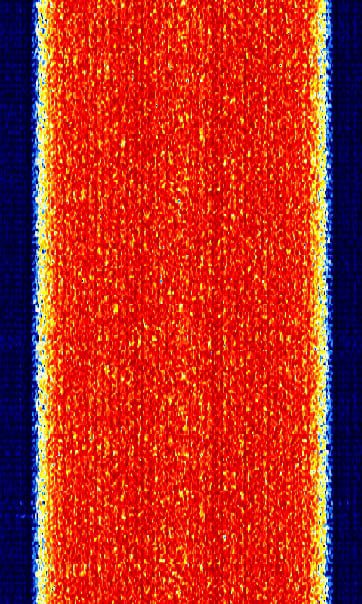
Western military data traffic on HF is carried by a family of single-carrier PSK modems. They look alike on a waterfall: a featureless, flat-topped block about 3 kHz wide. They differ in framing, rates and where they are used.
STANAG 4285: the broadcast modem
STANAG 4285 is defined in NATO’s “Characteristics of 1200/2400/3600 Bits per Second Single Tone Modulators/Demodulators for HF Radio Links”. Sigidwiki describes it as “very similar” to the MIL-STD-188-110 serial tone1. It always runs at 2400 baud. The user rate is changed by switching modulation and FEC:
| User rate | Modulation | FEC rate | Interleaving |
|---|---|---|---|
| 3600 bps | 8PSK | none | none |
| 2400 bps | 8PSK | 2/3 | short or long |
| 1200 bps | QPSK | 1/2 | short or long |
| 600 bps | BPSK | 1/2 | short or long |
| 300 bps | BPSK | 1/4 | short or long |
| 150 bps | BPSK | 1/8 | short or long |
| 75 bps | BPSK | 1/16 | short or long |
Short interleaving gets messages through faster but copes less well with fading. Long interleaving takes longer and is more robust1. RapidM explains why the mode is so easy to find. The older STANAG waveforms “find use in shore to ship and strategic broadcast systems” and are “well suited to broadcast because of the built-in continuous synchronisation sequences”. RapidM lists 4285 as in use for “NATO BRASS Systems, B/Cast Systems” 2. A naval broadcast transmitter keys continuously whether or not it has traffic, so a 4285 signal stays on a frequency for hours. That is why it is one of the most commonly logged military signals in Europe. The payload is almost always encrypted: you can demodulate the modem, but you will not read the messages.
MIL-STD-188-110 / STANAG 4539 and the ARQ layer
The serial-tone modem of MIL-STD-188-110B/D and STANAG 4539 is, in RapidM’s words, “the same waveform”, often called “110B”2. It is the standard choice for point-to-point data rather than broadcast. Rates run 75–9600 bps in 3 kHz, and Appendix F’s independent-sideband version reaches 19,200 bps in 6 kHz 2. RapidM says it is “normally associated with the STANAG 5066 ARQ protocol”. Its autobaud capability lets STANAG 5066 change data rate quickly as the ionosphere changes, and it is “often coupled with 2nd or 3rd Generation ALE”2. All of these narrowband PSK waveforms except STANAG 4529 use one carrier centred at 1800 Hz at 2400 symbols per second, with rate-1/2, K=7 convolutional coding2.
| Status (RapidM) | Waveform | Max rate | Bandwidth | Use |
|---|---|---|---|---|
| in use | STANAG 4481 (FSK) | 75 bps | 120 Hz | NATO ship-to-ship minimum requirement |
| in use | STANAG 4415 (NATO robust) | 75 bps | 3000 Hz | Robust low-rate mode |
| in use | MIL-STD-188-110A | 2400 bps | 3000 Hz | Legacy serial tone |
| in use | STANAG 4539 / 110B | 9600 bps | 3000 Hz | ARQ with fast data-rate change |
| in use | 110B Appendix F | 19200 bps | 6000 Hz | Two-ISB ARQ |
| in use | STANAG 4285 | 2400 bps | 3000 Hz | BRASS, broadcast |
| in use | STANAG 4481 PSK | 300 bps | 3000 Hz | Ship-to-ship |
| rare | STANAG 4529 | 1200 bps | 1500 Hz | Broadcast, “2 per 3 kHz channel” |
The 4285 row above gives RapidM’s 2400 bps maximum, which is the coded rate. Sigidwiki’s 3600 bps is the uncoded mode12.
Chat over HF: XMPP on STANAG 5066
A newer use of this stack is visible on the air. Sigidwiki documents military XMPP multi-user chat sent over STANAG 5066, using the 110A serial waveform at a fixed 600 bps. It has been logged on frequencies between 2082.5 and 7807.2 kHz, including 3112.2, 4022.2 and 5742.2 kHz19. The page describes XMPP as “widely used for military deployments, where operation over constrained and degraded networks is often essential”19. In practice, group chat is replacing teletype-style message handling in tactical HF networks.
Automatic Link Establishment: 2G still dominates, 4G arriving
ALE lets HF radio work more like a telephone. Every station in a network keeps scanning a list of channels. When an operator “dials” an address, the controller picks the best idle channel for that destination, checks that it is clear, and sends a short selective call. The called station stops scanning, the two controllers handshake to confirm the link is good enough, and only then are the operators told the circuit is up15. Idle stations also send periodic soundings, so every radio builds a running picture of which frequencies reach which partners. Those soundings are why ALE bursts appear across the HF spectrum, day and night, wherever military, government or NGO networks operate.
2G ALE (MIL-STD-188-141A/B Appendix A)
Second-generation ALE uses 8-tone MFSK at 125 baud with 250 Hz tone spacing, which gives a 2 kHz wide signal in USB. Sigidwiki has logged it from 3.068 to 28.3125 MHz 15. The wiki says the vast majority of ALE systems in use “at the present time are 2G ALE”15. That matches what monitors see. 2G is in US and allied military networks, the USAF HF Global Communications System, government agencies, embassies and humanitarian organisations, and amateur ALE nets. A hobby decoder shows the station addresses in plain ASCII, which is why ALE logs are the main way monitors identify networks. Hobby decoders include MultiPSK (which labels it “141A”), Black Cat ALE, PC-ALE and Sorcerer; professional tools include go2DECODE and Hoka15.
3G ALE (STANAG 4538)
Third generation adds burst PSK waveforms, synchronous scanning and faster link set-up (FLSU). It shares the 1800 Hz, 2400-symbol serial-tone core16. 3G has been fielded, but the sources describe it as a minority alongside 2G rather than its replacement.
4G ALE / WALE (MIL-STD-188-141D Appendices G and H)
Fourth-generation ALE is built for wideband HF. The handshake still runs in a normal 3 kHz channel, using one of two 8PSK burst waveforms at 2400 symbols per second on an 1800 Hz subcarrier16:
- Deep WALE: a 240 ms Walsh-coded preamble and about 1.28 s per PDU. Very robust, but slow.
- Fast WALE: a 120 ms preamble and about 120 ms per PDU.
During the handshake each side reports the spectrum it can use as 16-element sub-channel vectors of 1.5 or 3 kHz each. The traffic channel, up to 48 kHz, is computed independently for each direction, so a link can route around local interference16. 4G stations can still place and accept 2G calls and 3G FLSU calls. With linking protection enabled, PDUs are encrypted with HALFLOOP-96 16.
Sources: sigidwiki 2G and 4G ALE pages.
For a listener, the practical result is that 2G ALE will stay the most readable military signal on HF for years. As networks move to 4G with linking protection, the plain-text addresses that make ALE logging possible will disappear.
Wideband HF: STANAG 5069 and MIL-STD-188-110D
The largest technical change in military HF over the past decade has been the move past the 3 kHz voice channel. MIL-STD-188-110D Appendix D and its NATO counterpart STANAG 5069 define wideband HF (WBHF) serial-tone waveforms in channels from 3 kHz to 48 kHz, in 3 kHz steps up to 24 kHz and then 30, 36, 42 and 48 kHz217. Within each bandwidth a waveform ID (WID) from 0 to 13 selects the modulation. The range runs from Walsh-coded and BPSK modes, through QPSK and 8PSK, up to 16-, 32-, 64- and 256-QAM2. Rates run from 75 bps at WID 0 in 3 kHz to 240,000 bps at WID 12 (256-QAM) in 48 kHz2.
Equipment is sold in four capability blocks:
Source: RapidM waveform tables.
According to RapidM, Block 1 is 3 kHz only, “with somewhat improved performance over STANAG 4539 3-kHz modems”. Block 2 adds 6, 9 and 12 kHz with K=7 coding. Blocks 3 and 4 extend to 24 and 48 kHz and add K=9 coding2. The same table shows how sharply rates fall when conditions are poor. A 48 kHz channel still carries only 1200 bps at WID 0, so the large figures depend on a very good channel2.
WBHF and 4G ALE are designed as a pair. The WALE handshake measures and negotiates the contiguous spectrum, and the 110D Appendix D modem then uses it16.
On the air, a wideband HF signal looks unlike anything else military: a flat block tens of kilohertz wide, often in the 2–8 MHz range where military fixed-service allocations are wide enough to hold it. The XMPP-over-5066 traffic described above has been logged with a 34 kHz occupied bandwidth19. This desk could not find a public count of how widely WBHF has been fielded. Vendors such as RapidM sell modems with Block 3 as standard and Block 4 as an option2, but deployment figures by service or nation are not public. For that reason it sits in the “emerging” tier here rather than among the most-heard modes.
Tactical data links: Link 11 and Link 22
Naval task forces share radar tracks with each other over tactical data links. On HF the older of these is Link 11, and its intended replacement is Link 22.
Link 11 (MIL-STD-6011 / STANAG 5511)
Link 11 dates back to the late 1950s, and its design history begins in 1957 18. It is a multitone, phase-modulated system. The HF version carries data at 2250 or 1364 bps, using the conventional (CLEW) or single-tone (SLEW) waveform18. A Link 11 net is controlled by a Net Control Station that polls each participating unit in turn in a roll call. Each ship answers with its track data before control passes on. The result has a recognisable rhythm on a waterfall: a short net-control interrogation, then a longer burst from the polled unit, repeated round the net. Wikipedia mentions a Link 11 recording on 4469.3 kHz in 2022 as an example of the system still in use18. Monitors in Europe and around the Mediterranean usually hear Link 11 during naval exercises rather than every day, which places it in the B tier. The content is encrypted.
RapidM’s table still lists STANAG 4539 Appendix F TDMA as “in use” for “Link 11 & Link 22 waveforms”, and describes STANAG 4539 TDMA as being “for use in older Link 22 systems”2. This desk could not establish a date for any NATO or US decision to retire Link 11 on HF.
Link 22 (NILE, STANAG 5522)
Link 22 came out of the NATO Improved Link Eleven (NILE) programme. Its stated purpose is to replace Link 11, “improve Allied interoperability”, “complement Link 16” and “enhance the commanders’ war fighting capability”22. It runs on HF and UHF. Between 2007 and 2009 Germany paid for work on Link 22’s HF fixed-frequency (HF-FF) mode. That work made the standard data rates more robust, extended gapless range to 1000 nautical miles and added high-speed waveforms. Germany submitted the HF-FF technology to NATO in 2012, and NILE approved it in 2015, with full support expected in 201622. Every implementation runs one shared System Network Controller software package owned by the NILE nations. It is not sold commercially and goes to third-party nations for an annual maintenance fee22.
- 1957Link 11 originsDevelopment of the multitone naval data link begins
- 2007–2009Link 22 HF-FF upgradeGermany funds robustness, 1000 NM gapless range, faster waveforms
- 2012HF-FF submitted to NATOOffered to NILE for adoption
- 2015NILE approves HF-FFFull support anticipated 2016
- 2022Link 11 still loggedRecording on 4469.3 kHz
Link 22 is harder to identify on HF than Link 11, and it is reported much less often in public monitoring logs. That fits a gradual transition in which navies still keep Link 11 for coalition interoperability.
Russian, Chinese and other non-NATO military signals
For a listener in Europe, a large share of the military HF activity that is not NATO comes from Russia. In the Pacific it comes from China. Most of it can be identified on a waterfall but not read: the modems are documented by the monitoring community, and the payloads are scrambled or encrypted.
Russian modems: CIS-12 and relatives
CIS-12, also catalogued as MS5, is associated with the Russian AT-3004D and AT-3104D modems. It is a parallel-tone PSK modem with 12 data tones at 120 baud, reaching up to 4800 bps in about a 3.1 kHz channel, with a pilot tone at about 3300 Hz 20. Sigidwiki states plainly that the content is scrambled, so decoding the modem does not yield readable text20. It belongs to a wider family of Russian parallel-tone and FSK modes catalogued by the wiki under its CIS entries. Since the full-scale invasion of Ukraine, Russian military HF has had particular attention from European monitors. This desk did not find a quantitative source on how its volume has changed, so none is claimed here.
Over-the-horizon radar
The loudest non-communications military signals on HF are over-the-horizon radars. Sigidwiki says Russia’s 29B6 “Kontayner” is “currently very active in Europe”21. Its features:
- Pulsed transmission with frequency modulation on pulse (FMOP), where many other OTH radars use FMCW. It usually runs at 40 pulses per second, which gives an unambiguous range of 3750 km.
- Bandwidths of 3.5, 7, 14 or 28 kHz, most often about 14 kHz, between 6.1 and 32 MHz, sometimes on several beams and frequencies at once21.
- About 150 antenna masts. The receive site is near Kovylkino in Mordovia. The original transmit site at Gorodets was dismantled around 2018–2019 and a new transmitter built near Kovylkino. A facility in Kaliningrad has been planned21.
The same wiki catalogues Chinese OTH radars (“OTH-SW” and “Foghorn”), Australia’s JORN, the US ROTHR, PLUTO II on Cyprus, and civilian CODAR ocean radars21. Some are loud enough to wipe out amateur and utility signals over a wide stretch of spectrum, and they are among the most frequently reported “interference” on the amateur bands.
Chinese data modes
The most widespread Chinese digital mode in public logs is the 30-tone OFDM modem, “believed to be used by Chinese military or other agencies”. Each burst opens with a four-tone QPSK preamble spaced 600 Hz apart, followed by 30 BPSK-modulated OFDM tones in about 3 kHz, with a pilot near 445 Hz. It is usually sent in LSB29. Sigidwiki describes “a massive amount of transmissions” and lists 80 unique frequencies from 3618 to 18,656 kHz 29. Related Chinese entries on the wiki include the 4+4 diplomatic mode, PRC-16 (16×75) and a 64-tone MFSK mode29.
Money on the ionosphere: HF links for high-frequency trading
The newest commercial user of HF is not shipping or aviation but finance. A skywave signal travels between continents at close to the speed of light in air. Light in optical fibre travels about a third slower, and fibre routes are not great circles. For a trader in Frankfurt reacting to a price move in Chicago, a few milliseconds of advantage is worth building transatlantic shortwave links for, even though they carry very little data.
Evidence that it is happening
The first public evidence came in 2018. Bob Van Valzah, a performance engineer and radio amateur (KE9YQ), noticed a tower in West Chicago, Illinois carrying four large log-periodic HF antennas and a microwave dish. It was registered as a U.S. Cellular site, and in the trash pile inside the fence was a box from an Ettus Research USRP X300 software-defined radio24. Using FCC database searches he found two more sites. The blog’s owner, who had covered microwave HFT networks since 2014, reported that “at least five HFT/market making firms” were behind shell companies building shortwave sites in the US, Germany and the UK, including one firm that had paid more than $1 million for a field24.
Raft Technologies, a vendor in this market, says trading firms have been adopting HF links “since early 2020”. It cites Deutsche Börse analysis showing that HF across CME (Chicago) to Eurex (Frankfurt) had replaced traditional links for trading DAX futures on ES signals. A mid-2022 analysis by Deutsche Börse’s Stefan Schlamp found HF speeds giving about a 9 ms advantage over the fastest transatlantic fibre-plus-microwave route23. In October 2024 the Financial Times reported on Skywave Networks and its claim that its “innovative and patented” technology addressed shortwave’s bandwidth problem31.
The transmissions are proprietary. No public decoder or published waveform exists, and this desk found no reliable monitoring description of what the signals look like on air. They are known to exist from the paper trail, not from logs.
The fight over rules: RM-11953
In 2023 the Shortwave Modernization Coalition (SMC), with Skywave Networks and FlexRadio among the parties named in the record, petitioned the FCC (RM-11953). It asked for new Part 90 rules allowing fixed, long-distance, non-voice communications above 2 MHz and below 25 MHz 2526. ARRL’s opposition sets out what was proposed26:
RM-11953: SMC proposal vs existing Part 90 HF rules (per ARRL filing)
3 changes
| Item | Before | After | Change |
|---|---|---|---|
| Signal bandwidth | One voice channel (~3 kHz) | Up to 50 kHz | Change |
| Power limit at least +13 dB | 1000 W PEP | 20,000 W average | Change |
| Out-of-band emission mask ARRL says sidebands could intrude up to 100 kHz into ham bands | Current Part 90 limits | ±250% of bandwidth, looser | Change |
Source: ARRL Opposition to RM-11953, August 2023. Proposal only; not adopted as of this report.
ARRL argued that the rules “would cause widespread disruption to Amateur and other communications services on multiple spectrum bands”, noting that many of the Part 90 bands sit directly next to amateur allocations only 300–450 kHz wide26. Comments were due on 31 July 2023 and reply comments on 15 August 2023, after the FCC refused Skywave’s and FlexRadio’s requests for more time2526. The ECFS filing history shows submissions continuing well after the comment cycle closed30.
Digital broadcasting: DRM on shortwave
Digital Radio Mondiale (DRM30) is the only digital mode used by international broadcasters on shortwave. On a waterfall it appears as a flat OFDM block, typically 10 kHz wide. It sits in the broadcast bands, so it is the easiest digital signal on HF to find with a cheap receiver running DREAM or a dedicated DRM set.
The DRM Consortium’s schedule for the B26 season (25 October 2026 – 27 March 2027) lists 45 broadcasts. It was updated on 26 October 2026, and some A26 entries are kept where B26 details are not yet confirmed27. The Consortium says the list is compiled from public sources and listener reports because “there is no single official directory of DRM broadcasts worldwide”, and that it is still provisional28. The same announcement marked the retirement of Jeff Cohen, who compiled the schedules for many years28.
The schedule is dominated by one broadcaster:
| Broadcaster | Example frequencies (kHz) | Site | Power |
|---|---|---|---|
| China National Radio | 13790, 17650, 17700, 11695, 9655 | Qiqihar, Kunming, Beijing, Urumqi, Dongfang | 30–150 kW |
| Radio Romania International | 15250, 21470, 9580 | Tiganesti | 90 kW |
| BBC World Service | 17575 (South Asia, 1500–1600 UTC) | Woofferton | 100 kW |
| Music 4 Joy | 13650 (Tue & Thu) | Nauen | 100 kW |
| Europasender Waldheim | 6195 (occasional) | Waldheim | 0.2 kW ERP |
Data from the B26 schedule27. The largest single CNR entry is 17700 kHz at 150 kW from Beijing27. Most CNR transmissions are domestic Chinese-language services aimed within China, so outside Asia the more realistic targets are RRI and the BBC’s DRM slot. The schedule’s mix of “confirmed”, “provisional” and “unverified” entries tells you how thin DRM’s shortwave footprint still is outside China and India. It is a real, regularly scheduled digital service, but a niche one.
Bottom line
Outside the amateur bands, the HF digital spectrum in late 2026 is shaped by three groups of users:
- Aviation’s HFDL is the busiest readable professional mode. Sixteen ground stations, published frequencies and free tools (dumphfdl, Airframes, hfdl.observer) make it the best first target. A 10 m wire and an RTL-SDR V4 are enough to start.
- Maritime HF has narrowed to DSC, weatherfax, weather RTTY and email. The US Coast Guard watches only HF DSC (4207.5, 6312, 8414.5, 12577 and 16804.5 kHz) and has stopped HF voice watch except on 4125 kHz at Kodiak and Guam. NBDP left the GMDSS on 1 January 2024. NOAA and DWD weatherfax and RTTY schedules are easy, decodable targets, but check the current schedules first.
- Military traffic is the largest share and mostly unreadable. STANAG 4285 broadcasts, 110B/4539 links running STANAG 5066, 2G ALE soundings, Link 11 during exercises, Russian CIS-12-family modems, Chinese 30-tone OFDM and OTH radars such as 29B6 fill much of the spectrum. You can identify these modes, but apart from ALE addresses you cannot read the content.
Two trends are worth watching. Wideband HF with 4G ALE will gradually remove both the 3 kHz signature and the readable addresses that monitoring depends on. HF trading links are a growing commercial use whose regulatory future depends on an FCC petition still open after three years. HF trading signals and Link 22 are the two areas where public evidence is thinnest, so treat any claim about their on-air volume with caution.
Terms used in this document (10)
- ADS-C — Automatic Dependent Surveillance – Contract — aircraft send position reports to air traffic control on an agreed schedule or when an event occurs.
- ALE — Automatic Link Establishment — a protocol that lets HF radios scan, sound and pick the best frequency automatically.
- BRASS — Broadcast and Ship-Shore — NATO’s maritime HF communications architecture for fleet broadcasts and ship-to-shore traffic.
- CPDLC — Controller–Pilot Data Link Communications — text clearances and requests exchanged between air traffic control and the cockpit instead of voice.
- GMDSS — Global Maritime Distress and Safety System — the IMO framework that sets which radio equipment ships must carry and watch.
- IOC — Index of cooperation — a fax parameter that sets the image’s aspect ratio; 576 is the standard for marine weather charts.
- MMSI — Maritime Mobile Service Identity — the nine-digit number that identifies a ship or coast station in DSC and AIS.
- NBDP — Narrow-band direct printing — maritime radio-telex (SITOR) used for safety messages and telex traffic.
- STANAG — NATO Standardization Agreement — the numbered NATO standards that define military modems and protocols.
- WALE — Wideband ALE — the fourth-generation link-establishment protocol that negotiates wideband HF channels.